
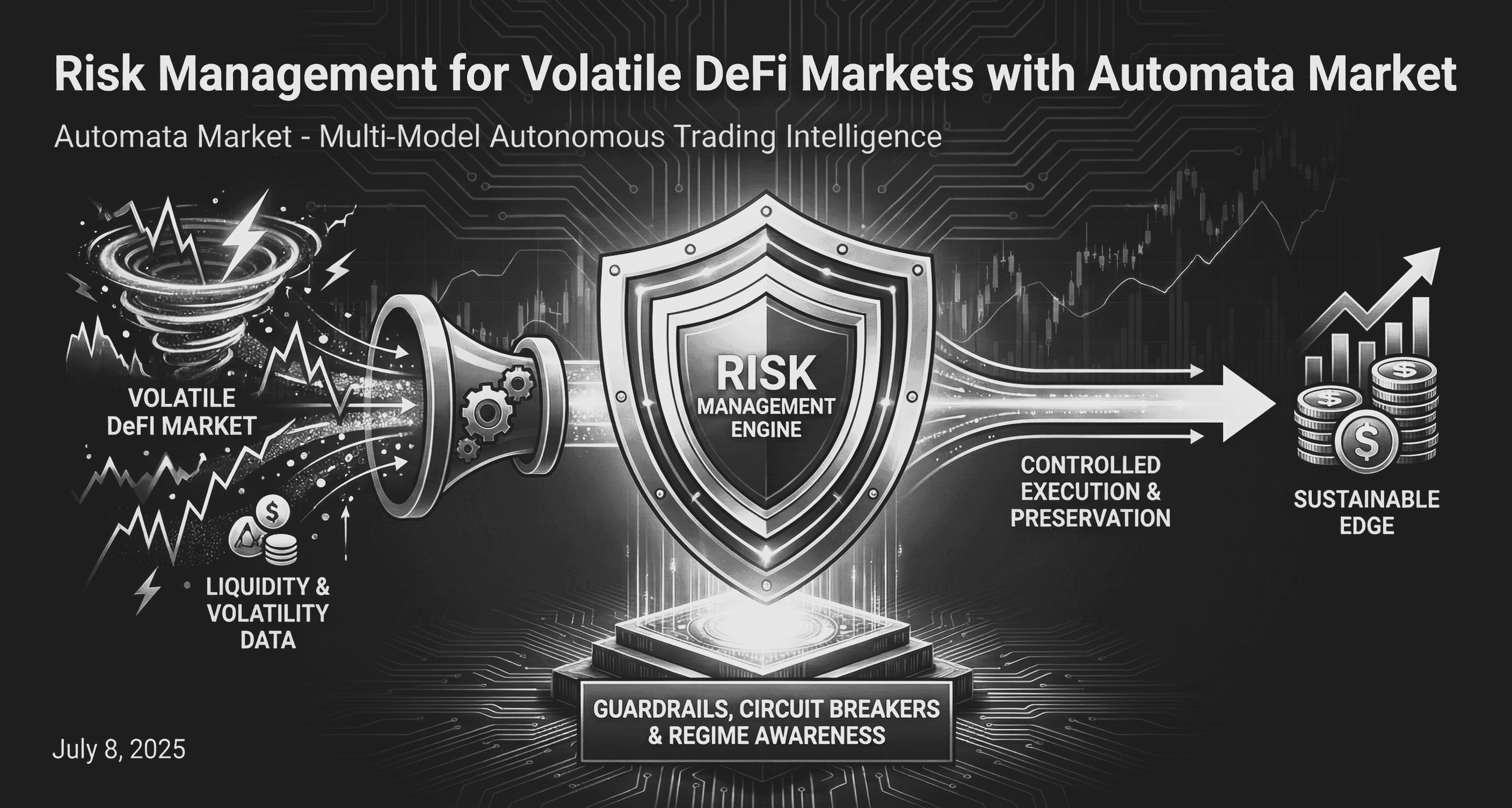

In DeFi, returns are visible, but risk is usually invisible—until it’s too late.
Most “AI trading” products focus on entries and exits. At Automata Market, we start with a different question:
How do we survive every regime long enough for edge to matter?
This article walks through how Automata Market’s multi-layer system handles risk as a first-class citizen, not a spreadsheet afterthought.
The Reality of Risk in DeFi
DeFi risk is not just “price going down.” It includes:
- Liquidity evaporating on a venue you rely on.
- Smart contract or protocol failure.
- Regime shifts where yesterday’s signal becomes today’s noise.
- Slippage and MEV quietly eating your P&L.
For a serious trader or fund, the goal is path control, not just end-state returns:
- Limit depth and duration of drawdowns.
- Avoid catastrophic tail events that permanently impair capital.
- Maintain liquidity and optionality when others are forced to exit.
Where Risk Lives in the Architecture
Automata Market’s layers interact to control risk at multiple points:
Data Layers (1–2)
   |
   v
Forecast Layers (3–4) ---(confidence, regime)---> Risk Layer (5)
                                              ---> Strategy Layer (6)
                                                   |
                                                   v
                                            Execution Layer (7)
                                                   |
                                                   v
                                            Feedback Layer (8)
Key idea: Risk is not a single checkbox.
It is woven through:
- How signals are generated (Layers 3–4).
- How positions are sized and constrained (Layer 5).
- Which strategies are even allowed to run (Layer 6).
- How trades actually hit the market (Layer 7).
Layer 5: The Dedicated Risk Engine
Layer 5 is where risk becomes explicit math and policy.
It continuously computes:
- Per-position risk (volatility, tail risk, liquidity profile).
- Portfolio-level risk (correlations, concentration, drawdown).
- Scenario impacts (e.g., sudden 30% gap move in majors).
Common concepts inside this layer:
- Volatility buckets – Position sizes adapt to realized and implied vol.
- Concentration caps – No single asset or sector can dominate exposure.
- Drawdown circuit-breakers – Systems scale down or pause when loss thresholds are hit.
Note: A good signal with too much size is more dangerous than a mediocre signal with conservative sizing.
Sample Risk Flow
Raw Signal: +2.0 Sharpe expectation
Vol Bucket: High
Liquidity: Medium
Correlation to book: Elevated

--> Layer 5 transforms this into a conservative position,
    or even zero, depending on current book risk.
Regime Awareness: When Not to Play
One of the most underrated forms of risk management is knowing when not to trade.
Automata Market uses:
- Volatility regimes (low, medium, high, chaotic).
- Liquidity regimes (deep, normal, thin).
- Correlation regimes (diversified vs “everything is one trade”).
to decide whether a strategy should be active at all.
Examples:
- In hyper-correlated crashes, mean-reversion systems are heavily down-weighted or paused.
- When liquidity thins, execution aggressiveness is reduced and notional caps are tightened.
From a user perspective, this looks like:
- Fewer but higher-quality trades in stressed conditions.
- Smaller step changes in equity curve, instead of cliff risks.
Strategy-Level Risk Controls
Each strategy type (momentum, arb, mean-reversion, carry, etc.) has:
- Its own allowed drawdown budget.
- Its own turnover and holding period envelope.
- Its own leverage ceiling.
Layer 6 enforces:
- Guardrails – Strategies cannot exceed their risk budget even if signals are strong.
- Rebalancing – Capital can be reallocated away from underperforming or over-risky strategies.
Portfolio Risk Budget
   |
   +--> Strategy A (Momentum)   - max X% drawdown, Yx leverage
   +--> Strategy B (Mean-Revert)- max X% drawdown, lower leverage
   +--> Strategy C (Arb)        - tighter caps, but high turnover
This ensures:
- No single strategy can hijack the book.
- Under-the-hood experiments don’t leak into production-sized risk.
Execution Risk: Slippage, MEV, and Venue Selection
Even with perfect signals and sizing, you can lose money through execution drag.
Layer 7 mitigates:
- Slippage – Using smart order splitting across venues and time.
- MEV exposure – Routing trades to reduce toxic sandwiching opportunities.
- Gas risk – Avoiding trades where costs meaningfully erode expected edge.
For traders: Think of Layer 7 as turning your “limit order” intuition into a programmatic execution algorithm that respects your constraints.
Feedback: Learning From Risk Outcomes
Layer 8 doesn’t just learn from P&L, it learns from risk behavior:
- Which strategies deliver acceptable returns per unit of risk?
- Where did realized volatility or drawdown exceed expectations?
- Which environments are historically dangerous for specific signals?
Over time, this leads to:
- Stricter rules in systematically dangerous regimes.
- More generous risk budgets where the system has earned trust.
What This Means for You
For individual traders:
- You get a risk framework by default, not something you have to build.
- You can express preferences instead of writing code:
- Max acceptable drawdown.
- Volatility comfort range.
- Capital allocations by strategy bucket.
For funds:
- You can treat Automata Market as a modular risk engine:
- Clear ownership of risk decisions per layer.
- Auditability of why trades were or weren’t taken.
- Ability to calibrate parameters to your governance process.
Practical Takeaways
- Survival > optimization. Capital that survives can always be reallocated.
- Risk should be explicit. If it only lives in someone’s head or a spreadsheet, it’s not enough.
- Architecture matters. By giving risk its own layer, Automata Market keeps it front and center.
If you want exposure to DeFi without betting your entire book on “it’ll probably be fine”, you need a stack that treats risk as a product feature—not a disclaimer.
See how this risk engine works in practice at automatamarket.com.