

Automated trading only works as well as the structure behind it.
Most tools bolt a single model on top of noisy market data and call it “AI.”
At Automata Market, we took the opposite route: design the architecture first, then fill it with the right models.
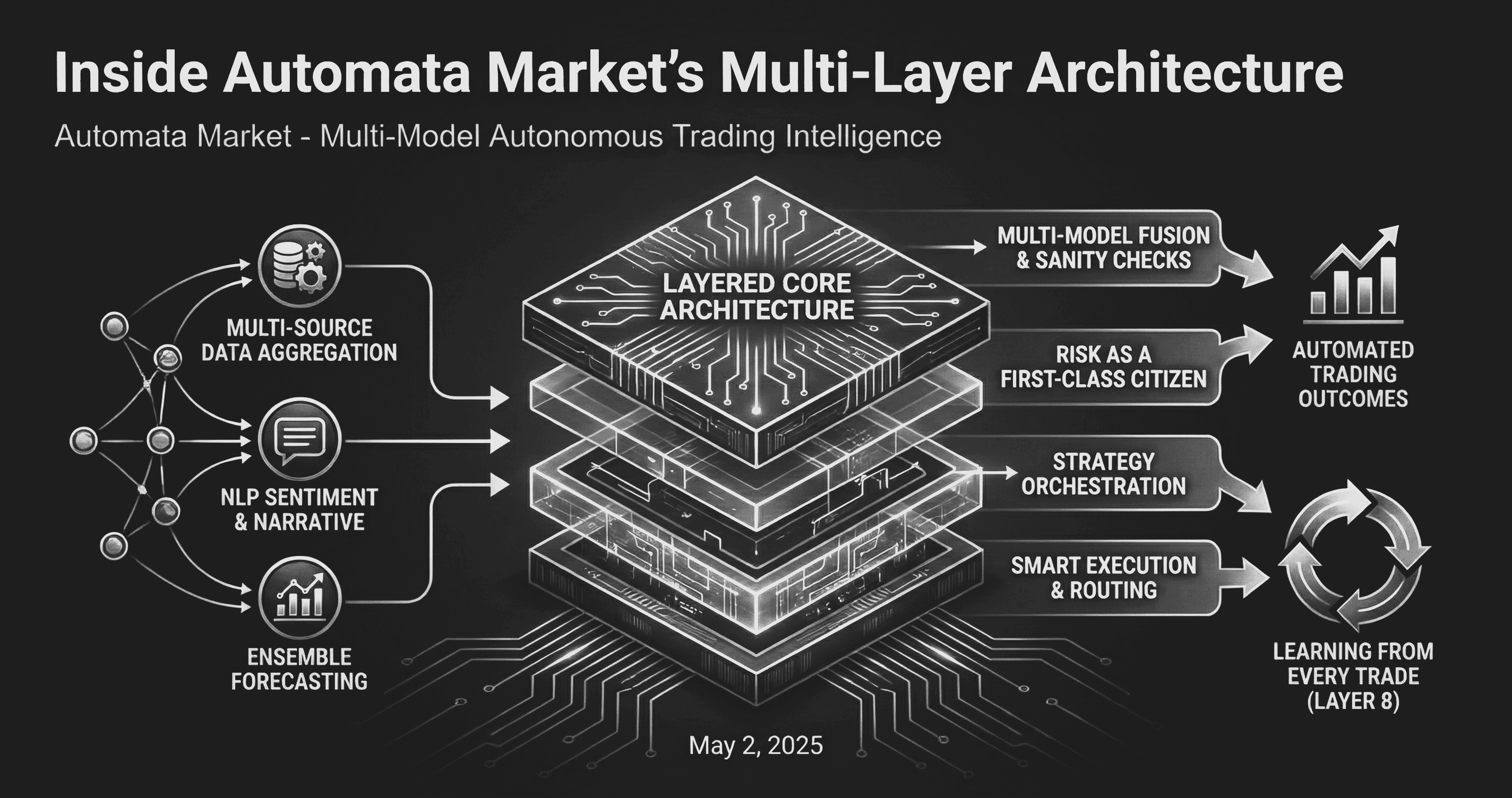
This article walks through that architecture in detail so you can understand how decisions are really made and why a multi-layer system is meaningfully different from a “smart bot.”
Why Architecture Matters More Than Any Single Model
From a trader or fund’s point of view, three questions matter:
- What signals are we using?
- How are those signals combined?
- What happens when they are wrong?
Single-model systems usually fail these tests:
- They overfit to one regime (e.g., trending bull markets).
- They lack cross-checks between different kinds of intelligence.
- They struggle when data is missing, delayed, or conflicting.
Note: Over a long enough horizon, every model will be wrong.
The question is whether the system can absorb that error without blowing up capital.
High-Level View of the Multi-Layer System
At Automata Market, decisions are produced by multiple specialized layers, each with a narrow, well-defined responsibility.
Here’s the flow at a glance:
Raw Data  ->  Feature Extraction  ->  Predictions  ->  Risk Filters
           (Layers 1–3)              (Layers 3–4)     (Layer 5)

Predictions + Risk  ->  Strategy Selection  ->  Execution  ->  Feedback Loop
               (Layer 6)                      (Layer 7)        (Layer 8)
Instead of one monolithic “black box,” we have:
- Data-focused layers that ensure inputs are rich and clean.
- Model-focused layers that generate and cross-validate predictions.
- Control-focused layers that manage risk, strategy, and execution.
Layer 1–2: Making the Market Legible
Layer 1 – Multi-Source Data Aggregation
Layer 1 ingests:
- CEX/DEX order books and trades
- On-chain events and liquidity data
- Funding rates, open interest, and volatility measures
- Protocol-specific metrics (TVL, emissions, lock-ups, etc.)
Its job is not to predict. Its job is to:
- Normalize and align timestamps across heterogeneous sources.
- Detect and handle gaps, delays, and anomalies.
- Create a unified “market state” that downstream layers can use.
For funds: Treat Layer 1 as your data operations team that never sleeps.
Every layer above it assumes this foundation is reliable.
Layer 2 – NLP Sentiment & Narrative Layer
Crypto is reflexive: price chases narrative as much as fundamentals.
Layer 2 uses NLP models to:
- Scan social media, news, and protocol announcements.
- Score sentiment at asset, sector, and market levels.
- Detect shifts in narrative regimes (e.g., “AI tokens,” “L2 wars”).
This layer produces features such as:
- Short-term sentiment momentum
- Topic clustering (what themes are emerging?)
- Narrative divergence (price up, sentiment flat, or vice versa)
These signals are then fed into forecasting and strategy layers—not as “truth,” but as context.
Layers 3–4: Forecasting and Cross-Validation
Layer 3 – Ensemble Time-Series Forecasting
Layer 3 runs multiple forecasting models (e.g., LSTM variants and other sequence models) in parallel.
Why an ensemble?
- Different models capture different structures: mean-reversion, momentum, volatility clustering, etc.
- Ensembles reduce variance and make the system less brittle.
Internally, this layer:
- Produces probability-weighted views of future returns and volatility.
- Tracks model confidence and degradation over time.
- Surfaces disagreements between models as an explicit signal.
Layer 4 – Multi-Model Fusion & Sanity Checks
Layer 4 is where “AI” turns into risk-aware signal.
It takes in:
- Forecasts from Layer 3
- Sentiment and structural features from Layers 1–2
- Hand-crafted risk factors and market structure features
Then it:
- Cross-validates predictions with non-correlated signals.
- Detects when forecasts are driven by fragile inputs (e.g., thin liquidity).
- Suppresses trades in environments where the ensemble is likely to fail.
Think of Layer 4 as the IC committee that asks:
“Do we truly have multiple independent reasons to put risk on here?”
Layer 5: Risk as a First-Class Citizen
Risk is not an afterthought in Automata Market’s architecture; it has its own dedicated layer.
Layer 5:
- Computes portfolio and position-level risk in real time.
- Applies constraints based on:
- Maximum drawdown thresholds
- Volatility buckets
- Asset- and sector-level concentration limits
- Adjusts sizing as volatility and liquidity change.
Signal Strength  --->  Target Position
Risk Constraints --->  Adjusted Position (what actually gets traded)
Note: This is where many “profitable backtests” die.
A trade that looks great in isolation may be unacceptable once you account for portfolio-level risk.
Layers 6–7: Strategy Orchestration and Execution
Layer 6 – Strategy Orchestration
Most traders run multiple styles at once:
- Trend-following
- Mean-reversion
- Basis/arb
- Volatility harvesting
Layer 6 decides which playbook is live given current conditions.
It considers:
- Market regime classification (trend vs chop vs shock)
- Liquidity conditions (can we get in and out?)
- Cross-asset correlations (is the whole market one trade?)
Outputs of this layer:
- Strategy weights (e.g., 60% momentum, 20% carry, 20% mean-reversion)
- Cooldowns when regimes are unstable
- Guardrails for max leverage and exposure per strategy
Layer 7 – Smart Execution & Routing
Good ideas can still lose money if they’re executed poorly.
Layer 7 focuses on:
- Venue selection (which DEX/CEX is best right now?)
- Order slicing to minimize slippage and impact
- Gas optimization and MEV-aware routing
Strategy Intent
   |
   v
Execution Layer
   |
   +--> Split orders
   +--> Choose venues
   +--> Monitor fills and slippage
From a user perspective, this is where “click once” turns into dozens or hundreds of atomic, optimized actions.
Layer 8: Learning From Every Trade
The final layer is the feedback loop.
Layer 8 continuously:
- Compares realized outcomes vs. model expectations.
- Attributes P&L to specific signals, strategies, and regimes.
- Updates policies and parameters where evidence is strong.
Crucially:
- Not every mistake leads to an update—this avoids overreacting to noise.
- The system looks for persistent mispricings in its own beliefs.
For funds: Think of Layer 8 as your permanent post-trade review process, automated and always-on.
How This Translates Into Trader Outcomes
For an individual trader:
- You get exposure to an institutional-style stack without hiring quants, devs, and infra engineers.
- You can focus on:
- Allocations (how much capital per strategy)
- Constraints (max drawdown, volatility comfort)
- Time horizon (intraday vs swing)
For a fund or desk:
- The architecture is designed to be:
- Auditable – each layer has a clear responsibility.
- Extensible – new data sources and models can be slotted in.
- Risk-aware – decisions are never purely “model says so.”
Key Takeaways
- Architecture beats any single model. Multi-layer design turns raw data into structured, risk-aware action.
- Separation of concerns (data, prediction, risk, execution, learning) makes the system more robust and auditable.
- Continuous learning ensures the stack doesn’t freeze in yesterday’s regime.
If you want a trading system that behaves more like an institutional desk than a hobbyist script, architecture is where the edge begins.
Explore the full system in action at automatamarket.com.