

Most trading systems age badly.
They are tuned to a specific market regime:
- Low-rate, risk-on environments.
- One dominant narrative (e.g., DeFi Summer, NFT mania).
- A certain level of volatility and liquidity.
Once those conditions change, performance deteriorates—and there’s no systematic way to adapt.
In Automata Market, continuous learning is not a buzzword. It is embedded as a dedicated layer in the architecture that:
- Observes outcomes.
- Attributes what worked and what didn’t.
- Updates behavior carefully over time.
This article explains how that learning loop works in plain language.
Learning Without Blowing Up
The biggest challenge of “learning systems” in trading is:
How do you learn from new data without overreacting to short-term noise?
Two naive extremes:
- Never update – The system gradually becomes irrelevant.
- Update constantly – The system chases every blip and whipsaws itself to death.
Automata Market’s approach is to:
- Separate fast signals from slow beliefs.
- Only update slow beliefs when there is consistent evidence.
Where Learning Fits in the Architecture
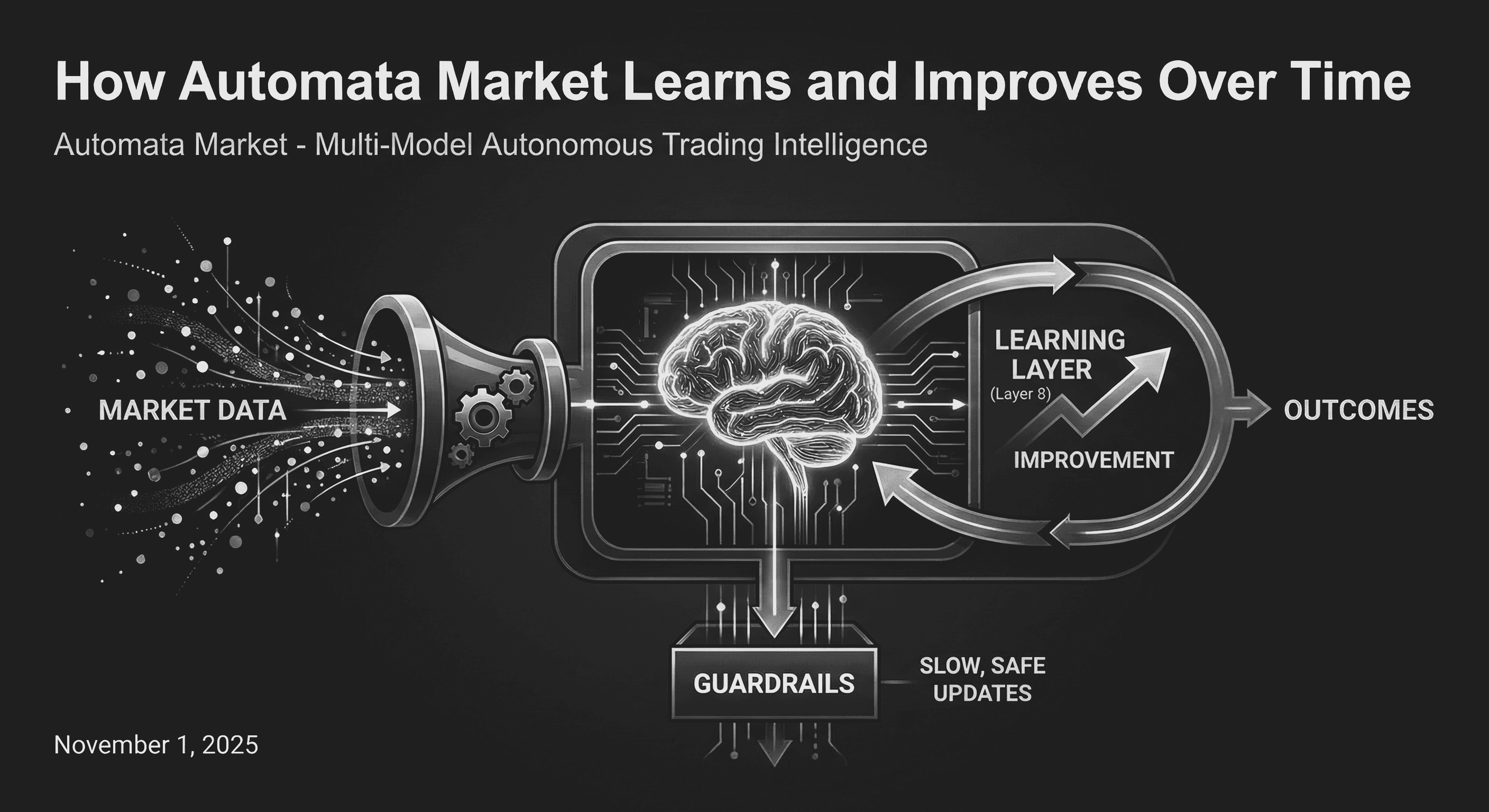
Here is a simplified view of the loop:
Environment  --->  Actions (Trades)  --->  Outcomes (P&L, Risk, Regimes)
     ^                                             |
     |                                             v
     +----------------- Learning Layer <-----------+
Mapped to the multi-layer stack:
Layers 1–7: Observe, predict, size, choose strategies, execute.
Layer 8   : Evaluate and adjust how layers 3–7 behave over time.
Layer 8 is not “one more model.” It is a meta-layer that:
- Watches the entire decision process.
- Scores policies, not just individual trades.
What Gets Measured
To learn effectively, the system tracks more than just raw P&L.
Some of the dimensions it monitors:
- Strategy-level performance
- Sharpe / Sortino ratios.
- Hit rates and payoff distributions.
- Risk efficiency
- Return per unit of drawdown.
- Volatility vs target.
- Regime performance
- Which strategies work in which volatility/liquidity regimes.
- Which signals degrade in specific environments.
Think of these as scorecards for:
- Individual signals.
- Strategy combinations.
- Execution policies.
Example Learning Loop: Momentum Strategy
Consider a momentum sleeve:
- Initial configuration
- Medium-term trend-following horizon.
- Position scaling based on breakout strength and volume.
- Volatility target range.
- Observed outcomes over time
- Good performance in smooth uptrends.
- Weak performance in violent range-bound chop.
- Layer 8 adjustments
- Reduce activation of momentum in high-volatility, low-liquidity chop regimes.
- Increase emphasis on confirmation signals (e.g., sentiment, breadth) before full sizing.
Diagrammatically:
Raw Policy  --->  Realized P&L Pattern  --->  Policy Update
 (Momentum)        (trend vs chop)           (more selective usage)
The key: This adjustment is gradual and regime-aware, not a blind flip from “on” to “off.”
Guardrails Around Learning
To keep the system stable, learning is constrained by several guardrails:
- Change caps per interval
- Policies can only move so far per period (e.g., per week/month).
- Prevents drastic lurches in behavior.
- Minimum evidence thresholds
- Changes require a statistically meaningful history.
- Avoids reacting to a single lucky or unlucky streak.
- Risk-first overrides
- If a policy change would violate global risk constraints, it is rejected or scaled down.
Note: These guardrails make learning feel more like a disciplined research process than a live experiment on your capital.
What Actually Gets Updated?
Layer 8 can influence:
- Signal weights
- Example: Reduce reliance on a signal that consistently underperforms in certain regimes.
- Strategy allocations
- Example: Shift capital from underperforming mean-reversion to more robust carry or momentum under specific conditions.
- Execution preferences
- Example: Favor certain venues or order types where historical slippage has been lower.
- Risk parameters within safe bounds
- Example: Tighten or loosen risk budgets for strategies that consistently over- or under-deliver on a risk-adjusted basis.
Importantly:
- The core architecture remains the same.
- Learning operates as a set of parameter and policy adjustments, not as uncontrolled rewrites.
Notes for Traders and Funds
For individual traders:
- You don’t have to manually “re-tune” the system for every market shift.
- You benefit from institutional-style post-trade analysis that runs continuously in the background.
For funds:
- You can think of Layer 8 as:
- A continuous model risk management function.
- An automated research assistant that flags where current policies are misaligned with reality.
- Because responsibilities are clearly separated by layer, you can:
- Audit what changed and why.
- Align learning behavior with your governance and oversight rules.
Key Takeaways
- Markets evolve; trading systems must learn or be replaced.
- Automata Market includes a dedicated learning layer that:
- Observes outcomes in detail.
- Updates slowly and safely.
- Respects global risk constraints.
- The result is a system that becomes more calibrated with experience—without chasing every short-term pattern.
If you want a trading partner that learns with you instead of locking you into a static model, Automata Market’s architecture is built for that future.
See how the full multi-layer system works at automatamarket.com.