
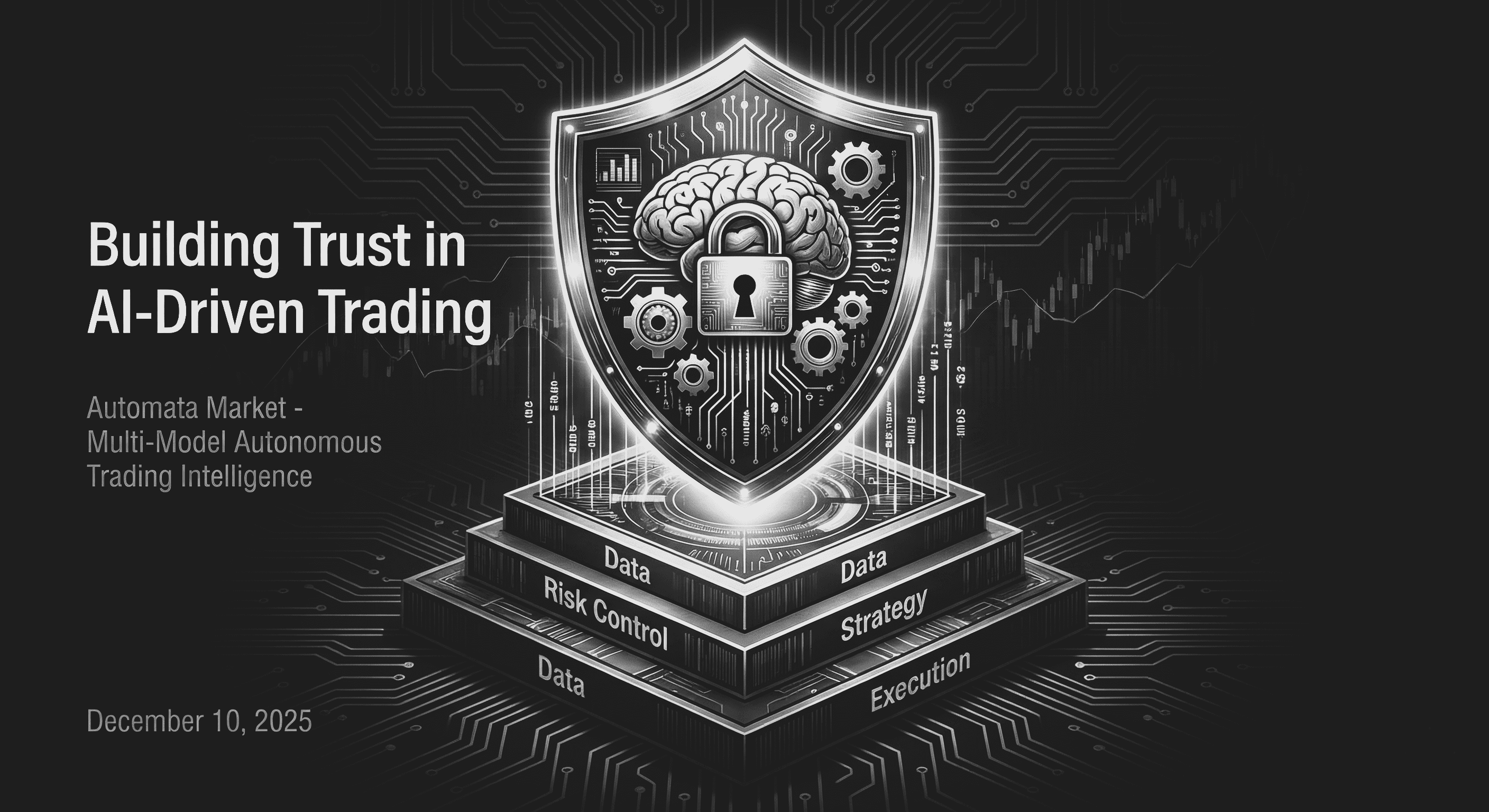

“Can I trust this with real money?”
That’s the only question that really matters.
Anyone can show a backtest, drop “AI” into a landing page, and promise alpha.
Earning trust from serious traders and funds is different. It requires:
- Clear boundaries around what the system can and cannot do.
- Transparency into how decisions are made.
- Safeguards that protect capital when things go wrong.
This article explains how Automata Market is designed to be trustworthy by architecture, not by marketing.
What Makes AI Trading Hard to Trust
AI trading systems trigger legitimate concerns:
- “Is this a black box I can’t audit?”
- “Can it suddenly change behavior without me knowing?”
- “What happens in edge cases, hacks, or black swan events?”
For institutions, there are additional constraints:
- Compliance and reporting requirements.
- Risk committees and investment guidelines.
- Need for clear ownership of decisions.
Automata Market addresses these by treating trust as a product feature, not an afterthought.
Architectural Transparency: Clear Responsibilities per Layer
The multi-layer design is intentionally modular and explainable.
At a high level:
Layers 1–2: Understand the market (data + sentiment)
Layers 3–4: Form views (forecasts + cross-checks)
Layer 5  : Control risk (sizing, limits, constraints)
Layer 6  : Choose strategies (which playbook runs)
Layer 7  : Execute (venues, orders, routing)
Layer 8  : Learn (slow policy adjustments)
Benefits for trust:
- You can point to where a bad outcome came from:
- Was it a data issue? A forecast error? A risk parameter?
- You can reason about changes:
- Updating Layer 3 models is different from changing Layer 5 risk rules.
Note: A “single big model” may look elegant, but it is much harder to explain, govern, and correct.
Guardrails and Hard Limits
Trust starts with what cannot happen, no matter what any model says.
Examples of hard constraints baked into the architecture:
- Max notional limits per asset, sector, and venue.
- Global and per-strategy drawdown thresholds.
- Leverage ceilings and margin safety buffers.
- Disaster brakes when markets are structurally impaired (e.g., chain halts, oracle failures).
These are enforced at:
- Layer 5 (Risk) – rejects or scales down positions that violate policy.
- Layer 6 (Strategy) – disables strategies that are unsafe in current regimes.
- Layer 7 (Execution) – adjusts or cancels orders if venue conditions degrade.
Even if a model is extremely confident, it cannot override these gates.
Visibility Into What the System Is Doing
To trust automation, you need to know:
- What is the system doing right now?
- Why is it doing that and not something else?
Automata Market supports:
- Position and exposure visibility
- Current holdings, per-strategy allocations, and risk usage.
- Activity logs
- What trades were executed, with timestamps and basic rationales.
- Regime and strategy states
- Which strategies are active, throttled, or paused—and under what market regime tag.
For funds, this makes it easier to:
- Answer questions from investment committees.
- Run internal reviews on whether the system behaved “as designed.”
Learning With Governance, Not Chaos
As described in the learning article, Layer 8 adjusts policies over time.
From a trust perspective, what matters is how constrained those adjustments are.
Key properties:
- Rate-limited change
- Policies evolve gradually, not overnight.
- Evidence thresholds
- No policy shifts on the basis of a handful of lucky or unlucky trades.
- Risk-aware overrides
- If a proposed update would push risk outside of agreed bounds, it is scaled or rejected.
For institutional users, this opens the door to:
- Align learning settings with internal governance.
- Define what is allowed to auto-update vs. what requires human review.
Failure Modes and How They’re Handled
Trust also means being explicit about failure modes:
- Data outages or corruption
- Layers above can:
- Fall back to degraded but safe modes.
- Reduce or pause activity until data quality recovers.
- Layers above can:
- Venue or protocol risk
- Execution layer monitors:
- Fill behavior.
- Latency and error patterns.
- Risk layer can:
- Cap exposure.
- Blacklist venues or instruments temporarily.
- Execution layer monitors:
- Model underperformance
- Learning layer:
- Detects persistent underperformance.
- De-emphasizes or retires specific signals or strategies within guardrails.
- Learning layer:
The emphasis is on controlled degradation:
- In worst-case scenarios, the system aims to do less, more safely, rather than push harder in the dark.
Human + Machine, Not Human vs Machine
Automata Market is built to be an amplifier, not a replacement, for informed humans.
For independent traders:
- You control:
- How much capital you allocate.
- Which strategy buckets you want active.
- Your drawdown and volatility comfort.
For funds:
- You can integrate Automata as:
- One sleeve among several.
- A systematic “lab” that runs well-defined playbooks.
- A co-pilot for execution rather than a black-box allocator.
In both cases, the final responsibility for using the system belongs to you—but the architecture is designed to make that responsibility manageable.
Key Trust Principles
Summarizing Automata Market’s approach:
- Transparency by design
- Clear separation of concerns across layers.
- Auditability for how and why trades were made.
- Safety before cleverness
- Hard risk guardrails that no model can ignore.
- Thoughtful handling of edge cases and degraded conditions.
- Governed learning
- Continuous improvement that respects risk and oversight.
If you’re going to trust an AI system with your trading capital, it should be by choice and understanding, not blind faith.
Automata Market is built so that you can make that choice with eyes open.
Learn more about the architecture, risk engine, and strategy design at automatamarket.com.