
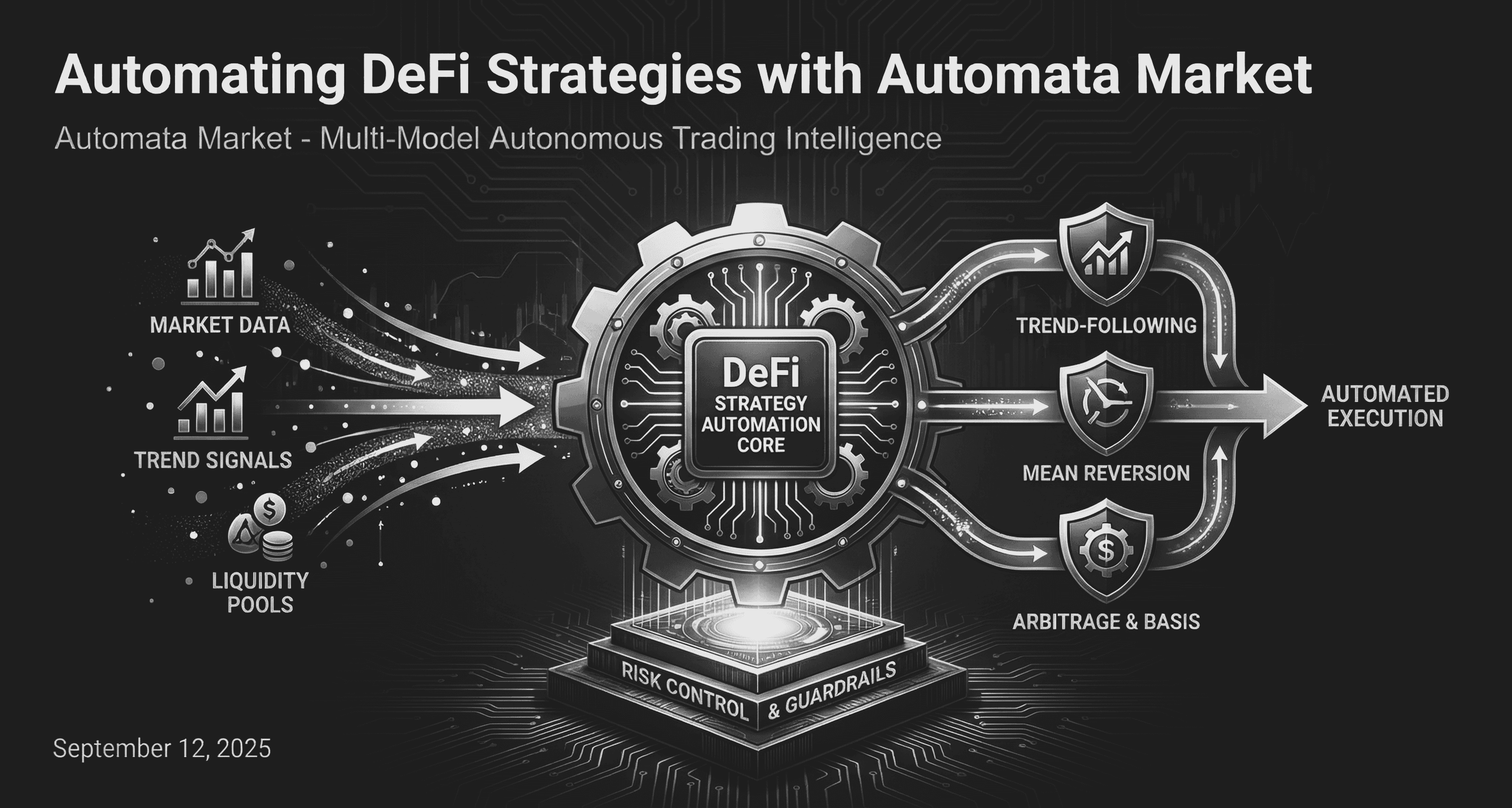

Most traders understand what DeFi strategies they want to run:
- “I want to capture funding rate dislocations.”
- “I want to ride strong trends without staring at charts.”
- “I want to fade obvious overreactions.”
The hard part is turning those ideas into reliable, 24/7 automation that doesn’t break when markets shift.
This article shows how Automata Market maps common DeFi strategies onto its multi-layer architecture—so you can think in terms of intent instead of code.
From Strategy Idea to Automated Pipeline
Let’s zoom out and see what happens between your intent and an on-chain trade:
Strategy Intent
  (e.g., "trend-follow BTC/ETH" or "arb price gaps")
       |
       v
 Market Understanding (Layers 1–2)
       |
       v
 Forecasts & Signals (Layers 3–4)
       |
       v
 Risk & Sizing (Layer 5)
       |
       v
 Strategy Orchestration (Layer 6)
       |
       v
 Smart Execution (Layer 7)
       |
       v
 Feedback & Learning (Layer 8)
Each strategy is not a separate “bot” bolted onto your account.
Instead, the same architecture powers multiple strategies in parallel.
Strategy 1: Momentum / Trend-Following
What Traders Want
- Participate in strong uptrends without micromanaging entries/exits.
- Avoid getting chopped up in sideways markets.
How the Layers Support It
- Layers 1–2: Aggregate price, volume, and narrative signals across venues.
- Layer 3: Forecasts short- to medium-horizon returns and volatility.
- Layer 4: Confirms that price action plus sentiment plus structure agree.
- Layer 5: Sizes positions based on volatility and portfolio risk.
- Layer 6: Turns all of this into a live momentum strategy that can be toggled on or off.
Example Flow
1. Price breaks above key ranges on strong volume.
2. Sentiment turns constructive after a neutral period.
3. Forecasts show positive expected returns with elevated but manageable vol.
4. Risk engine allocates a modest but non-trivial weight.
5. Execution layer scales into the trend with controlled slippage.
From your perspective:
- You define risk appetite and allocation to momentum.
- Automata handles entries, scaling, partial exits, and full de-risking when conditions break.
Strategy 2: Mean Reversion / Overreaction Fading
What Traders Want
- Fade short-term dislocations that are likely to snap back.
- Avoid fighting real trend reversals.
How the Layers Support It
- Layers 1–2: Track sudden price gaps, order book imbalances, and narrative spikes.
- Layer 3: Estimates likelihood that a move is temporary vs regime-changing.
- Layer 4: Looks for disagreement between narrative, volume, and structure.
- Layer 5: Caps size aggressively due to tail risks of “catching falling knives.”
- Layer 6: Only activates mean-reversion when regime classifiers say the market is range-bound or mildly trending.
Example Scenario
Asset dumps -15% on thin volume
Narrative: short-lived rumor, quickly debunked
Depth: still reasonable; no liquidity rug
Forecasts: high short-term negative return but
           positive medium-horizon expectation
The system may:
- Enter gradually with tight global risk budgets.
- Use time-based exits if price stabilizes but doesn’t fully revert.
- Disable the strategy entirely if:
- Liquidity vanishes
- Correlations spike
- Forecasts point to a genuine regime break
From your perspective:
- You gain systematic exposure to overreaction edges.
- You avoid manually staring at order books or Twitter during every spike.
Strategy 3: Arbitrage & Basis Opportunities
What Traders Want
- Monetize price differences across venues or instruments (e.g., spot vs perp).
- Avoid operational risk (stuck funds, failed transactions, unexpected liquidations).
How the Layers Support It
- Layer 1: Consumes cross-venue price feeds, funding rates, and order books.
- Layer 2: Monitors news and protocol events that may justify sustained dislocations.
- Layer 3–4: Determine whether spreads are likely to close or reflect structural changes.
- Layer 5: Limits notional per venue, counterparty, and collateral type.
- Layer 7: Executes carefully to avoid creating slippage that kills the very edge you’re chasing.
Basis Trade Example
Perpetual futures trading at +8% annualized premium
Spot is liquid across multiple venues
Risk engine confirms:
  - Collateralized exposure is within limits
  - Funding volatility is acceptable
  - Correlation with existing book is manageable
Actions:
- Open delta-neutral basis positions (long spot, short perp, or similar).
- Monitor funding, slippage, and market structure changes.
- Auto-adjust or close when:
- Premium compresses
- Funding flips direction
- Risk budget is needed elsewhere
How You Express Intent in Automata
Instead of coding strategies, you:
- Choose strategy buckets:
- Trend-following
- Mean-reversion
- Arbitrage / basis
- (And others as the platform evolves)
- Set:
- Risk allocations per bucket (e.g., 40% momentum, 30% arb, 30% mean-reversion).
- Max drawdown and volatility comfort levels.
- Time horizon preferences.
Automata Market then:
- Maps these preferences into layer-level parameters and guards.
- Continuously evaluates whether a given strategy should be:
- Active at full size.
- Throttled down.
- Temporarily sidelined.
Notes for Funds and Advanced Users
- You can treat Automata’s strategies as modular sleeves in your broader portfolio.
- Each strategy outputs:
- Trade logs
- Risk usage metrics
- Regime classification snapshots
- This makes it easier to:
- Justify risk usage to committees.
- Run post-trade reviews across strategies.
- Decide where to allocate incremental capital.
Key Takeaways
- Automata Market doesn’t just run “a bot”—it runs multiple strategy playbooks powered by the same multi-layer intelligence stack.
- You think in intent and risk buckets; the system handles forecasts, risk, orchestration, and execution.
- As market structure evolves, strategies adapt because the underlying layers adapt.
If you’re ready to move from ideas on a whiteboard to production-grade automation, Automata Market is built to be your execution partner, not just a dashboard.
Explore strategies and automation at automatamarket.com.